Problem one
Seventeen tabs, and he still is not sure.
The airline, two booking sites, then the airline again to see if direct is cheaper. By tab nine he has forgotten the first price.
TmAi case study · Bangalore · 2024
Rebecca Doshi had an idea for airlines and one question: would it hold up? Four months later I came back with the numbers, the pricing and a working prototype.
Morning. Where is work taking you?
Bengaluru, Thursday. Put a dosa on it.
Vistara 402, 08:15, business, direct. Seat 2A, the one you always take.
01 / 06
Who asked, what they asked, and my role.
Rebecca Doshi asked one question. Could an airline sell a seat without paying somebody else to sell it?
Airlines move billions of people a year and keep almost none of the money. Rebecca asked me to find the part of that business a designer could change, and to tell her honestly if there was nothing there.
I came back with an answer neither of us expected, and it changed the whole project.
The problem was never the seat. It was the way the seat gets sold.
02 / 06
One frequent flyer and three things that go wrong.
I sat with eleven frequent flyers. Arjun is all of them at once.
0tabs open
4months of inbox to dig through
3bookings for one trip
Problem one
The airline, two booking sites, then the airline again to see if direct is cheaper. By tab nine he has forgotten the first price.
Problem two
Every trip costs him twice: once to book, and again at quarter end, digging four months of confirmations out of his inbox. On a Sunday. He has come to hate Sundays.
Problem three
Three people, one meeting. Arjun puts every seat on his card and chases the money, or they book apart and sit scattered down the aircraft.
Nobody wakes up wanting to compare fares.
03 / 06
A conversation instead of a form, and what it does when a trip breaks.
Six dropdowns, a results page, a fare table, a seat map, a payment sheet. Most people quit at the fare table, so I designed a conversation instead.
17taps to a boarding pass
Bengaluru, Thursday. Put a dosa on it.
Looking for the best suited flight
Edge cases
A form waits for the traveller to find the problem. The agent finds it first and brings the fix.
Delays: DGCA data analysed by ThePrint. 109,607 of 354,775 departures at Delhi, Mumbai, Bengaluru and Hyderabad left late between January and September 2024.
Cancellations: DGCA monthly reports. 3.67 percent of scheduled domestic flights were cancelled in January 2024. Most other months sat between 0.6 and 1.9 percent.
Refunds: DGCA CAR Section 3, Series M, Part II, which gives airlines seven days to refund a ticket paid by card.
Currency: published card fees. Standard cards from India's largest banks add 3.5 percent to foreign currency spends, plus 18 percent GST on that markup.
%
Flights left late
India's four busiest airports, January to September 2024
%
Flights cancelled
January 2024 fog, Indian domestic
days
To refund a card payment
The DGCA deadline for airlines
%
Added to a dollar fare
Indian card markup, 3.5% plus GST
Before booking
01
Every stop is checked against his passport using IATA Timatic. Routes he cannot take never reach the shortlist.
02
Fares over his company's cap are flagged before he picks one. His manager approves in the thread.
03
Seat and fare are checked again at payment. If either has gone, he gets the closest match and approves any new price first.
At payment
04
The seat stays held at the same fare for thirty minutes while he tries another card or UPI.
05
He sees and pays in rupees at the quoted rate, so the statement matches the screen.
06
If the airline's system goes quiet, it says so. A charge with no ticket behind it is refunded automatically.
After booking
07
It watches the incoming aircraft, so Arjun hears about a delay before the gate does, with a flight that still makes his meeting.
08
The news arrives with a seat already held on the next good flight. One tap keeps it.
09
The new ticket keeps his seat, his meal, and his colleagues seated together.
10
It files the claim and tracks it in the thread until the money is back. Fare drops count too.
04 / 06
Where an airline's money actually goes.
IATA's 2025 forecast for every airline in the world: 979 billion dollars of revenue, and 36 billion of profit.
It is why the water bottle on board is 250ml and not 500ml. Every extra kilo in the air burns fuel that nobody paid for.
It also means there is almost nothing left to cut inside the aircraft. If you want to change an airline's economics, the cabin is the wrong place to look.
%
Industry net margin
2025 forecast, all carriers
$
Profit per passenger
Per flight flown
About half of all tickets sell through an agent or a booking system, and each one costs the airline around eight percent.
Eight percent of 489.5 billion dollars of indirect sales is 39.16 billion a year, paid to companies that never flew anybody anywhere.
That was the moment this stopped being a booking app and became a project about distribution.
$B
Paid to sell the seats
8% on $489.5B of indirect sales
%
Already booked direct
T2RL, passengers boarded, 2022
IATA industry outlook 2025 for revenue, profit and net margin.
T2RL on distribution share, 2022, for the split between direct and indirect booking.
Everything else is modelled from public industry data and the assumptions written on this page, not from any single carrier.
Airline keeps
$100.00
Cost of flying it
Fuel, crew, leases, maintenance, airport charges
Cost of selling it
Travel agent commission and booking system fees
What is left
The industry's 3.7 percent net margin
A hundred dollars of ticket revenue. All of it looks like the airline's money.
Most of it never was. Fuel, crew, leases, maintenance, airport charges.
Then the booking path takes its cut. A travel agent, a booking system, or both.
What survives is three dollars and seventy cents.
Sell it direct and that eight dollars stays. Same aircraft, same seat, same passenger.
$3.70 becomes $11.70. Three times the margin, on a seat that did not change.
The industry made 36 billion. It spent 39 billion getting the seats sold.
05 / 06
A working build, how it is organised, Arjun's trip end to end, and the pricing.
If the eight percent is the problem, stop paying it. People book wherever it is easiest, so direct had to become the easiest.
Easier than seventeen tabs meant no form at all. You say where you are going and it books, because it already knows your seat, your meal, your card and who you travel with.
Then I priced it as a membership, so the airline earns from a passenger even in months they never fly.
The agent lives inside the airline's own app.
Built into the airline's app
It sits where people already search and compare.
One button hands it over
Tap once, then talk to it like a person.
It does the searching
It asks what it needs and comes back with the three to five best options.
You choose, it books
Pick one. It books it and handles everything after.
The argument was about sequence rather than surface, so the flow came first. Every screen below came out of that file.
At first the conversation carried everything as plain text, so a flight was a paragraph you had to read. It worked, and it was slow to scan.
So every decision became a card the traveller could act on without leaving the thread. The plan screen got a clear recommendation, and the confirmation got the fare breakdown that later became the trust anchor in the live prototype.
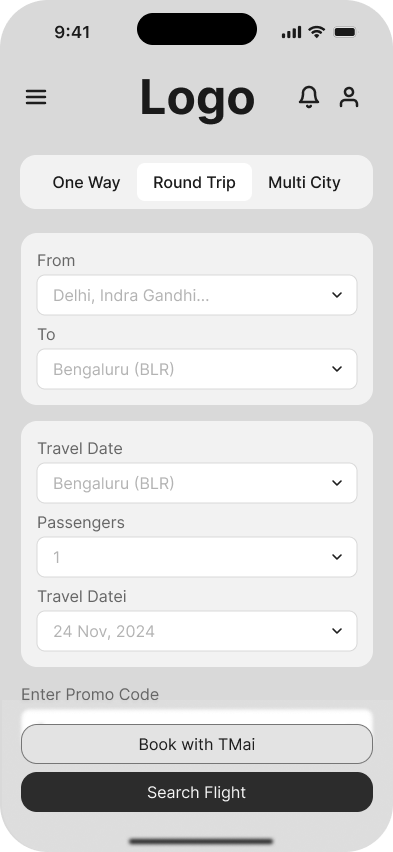
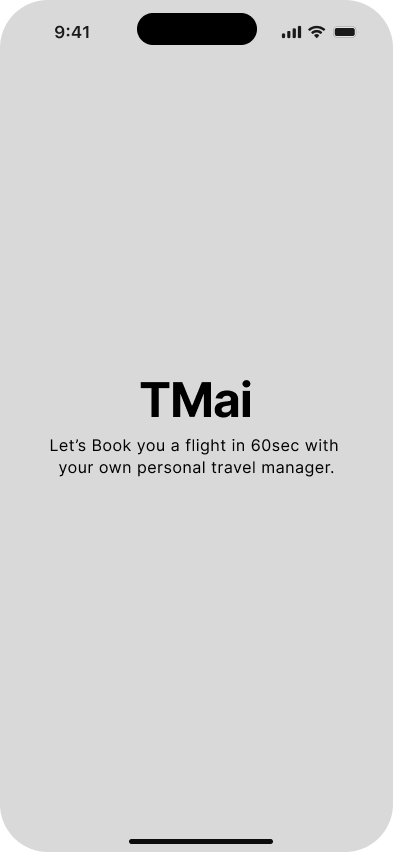
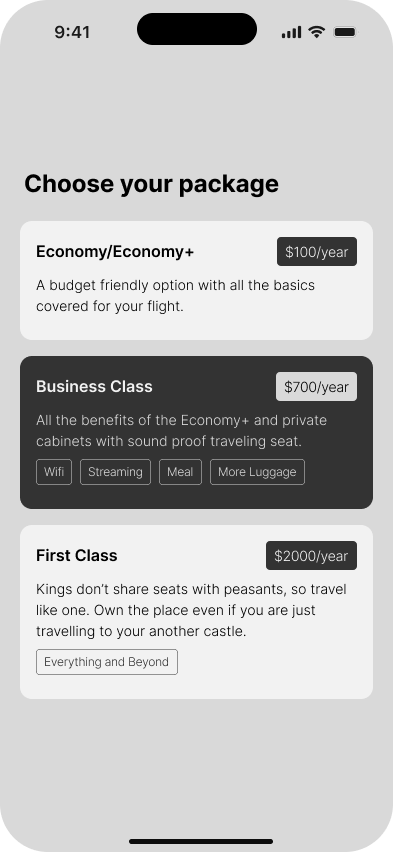
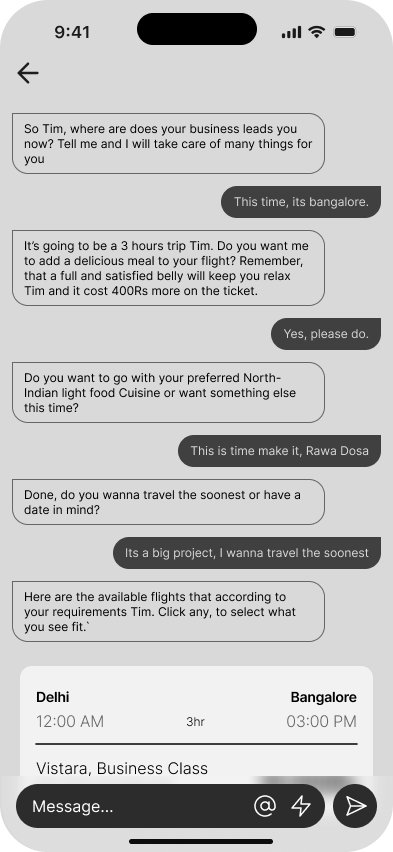
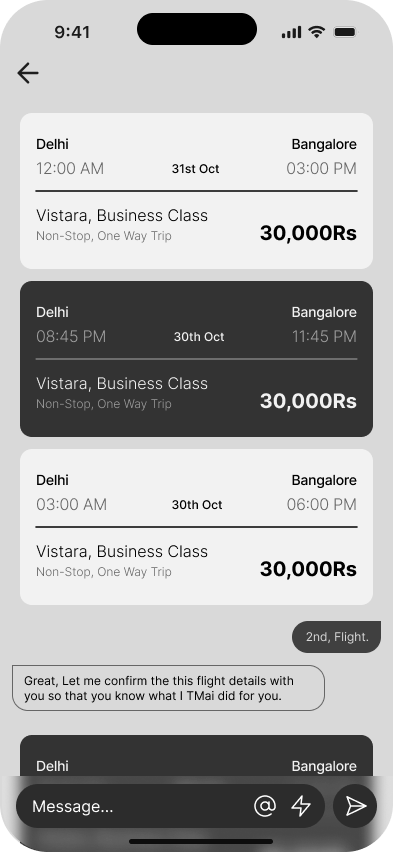
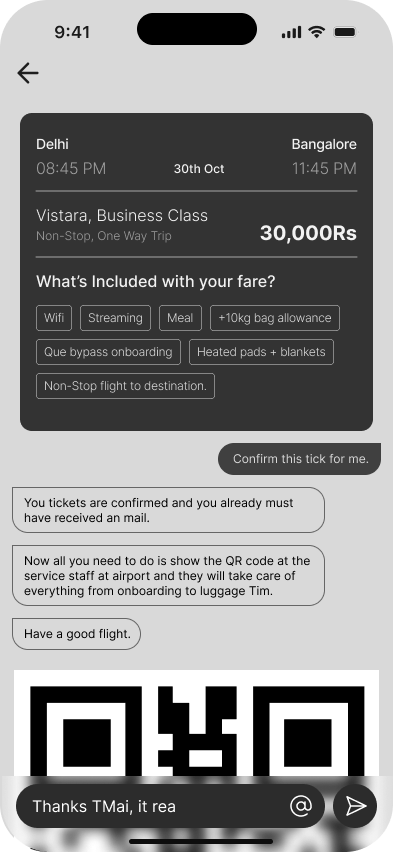
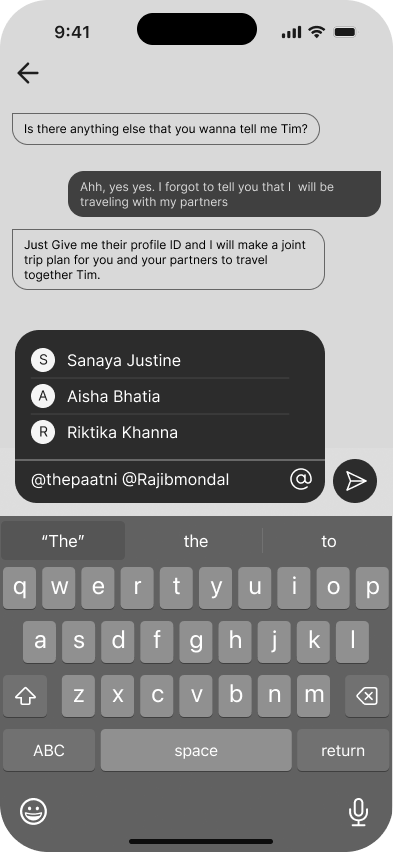
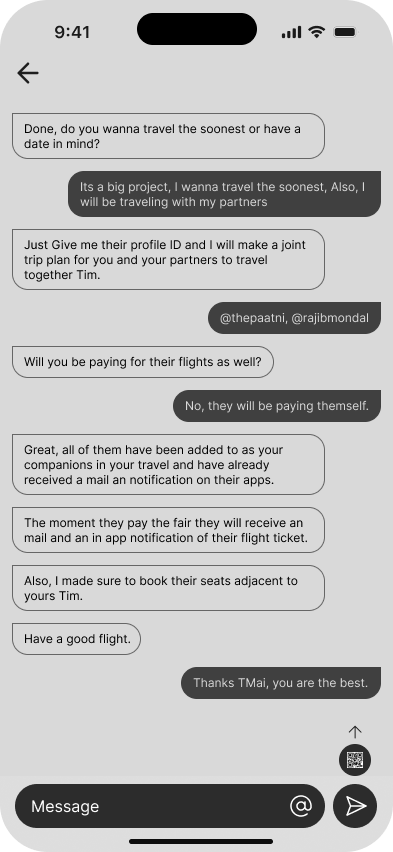
Six moments from the finished prototype, from the old form to a booked trip with the bill split.
Hover a screen to see what it solves.
Six dropdowns before a single fare appears.
And four more screens behind the search button.
Every tap is counted. Most people give up around the fare table.
One button hands the whole trip to the agent.
The only choice before the chat begins.
Business leads, because it is built for people who fly every week.
Priced per year, so the airline earns in months nobody flies.
What each tier adds, in a few words, not a feature table.
It types at reading pace, so replies land like a person's.
Passport, seat and card are already on file. Nothing to fill in.
The likely answers are one tap away.
Or say it in your own words.
It shows what it searched, so the shortlist can be trusted.
Three options instead of three hundred.
One full price per flight. No fare table to decode.
Picked for the trip, not just the route: landing before the first meeting.
Colleagues are tagged with an @, the way people already chat.
Each colleague gets a payment request for their own seat.
Arjun fronts nothing for anyone.
Seats beside him are held at the same fare for thirty minutes.
The boarding pass lands in the chat and the wallet.
Colleagues' payments are tracked in the same thread.
Distribution fee: zero. The airline keeps the eight percent.
Receipt emailed and filed for expenses. No Sunday lost to it.
Information architecture
One button in the airline's app opens TmAi. Every decision happens in one thread, and the rest stays on file so Arjun never types it twice.
Every extra tab is another place to look, which is the problem Arjun already has. So anything he has to decide arrives in the thread as a card he can act on.
The other screens are for looking things up: a past trip, a receipt, the passport on file. None of them asks him to do anything.
Airline appBook a flight
one button
TmAi
PlanChosen once
The threadWhere everything happens
TripsTo look things up
ProfileOn file
User journey map
One Bangalore to Delhi trip, told twice. Grey is how it goes today. Blue is the same trip with TmAi.
Calm
Stressed
01
A client meeting in Delhi on Thursday. An evening goes on travel.
He types one sentence.
02
Seventeen tabs, and still not sure.
Three flights that land before the meeting.
03
Every seat on his card, then he chases the money.
Colleagues tagged. Each pays for their own seat.
04
Digs the boarding pass out of his email.
The pass is already in the chat and the wallet.
05
Finds out at the gate and joins the queue.
Warned early, and already moved to a flight that makes the meeting.
31% of departures left late in 2024
06
A Sunday spent digging out receipts.
Receipts filed as he goes. Sunday stays his.
A yearly membership in three tiers, each priced against a job people already pay a travel agent to do.
$100a year · Economy Plus
$700a year · Business Class
$2,000a year · First Class
Tier one · $100 a year
This tier answers the seventeen tabs: one sentence books the trip. I priced it low on purpose. Its job is to move bookings onto the airline's own channel, where the eight percent stays with the airline.
Tier two · $700 a year
Priced for Arjun. At his pace the fare is not what hurts, the disruptions are. So it rebooks before a delay, refunds a fare that drops, checks visas and turns a quarter of receipts into one report.
Tier three · $2,000 a year
Nothing is left to automate, so it sells attention: a person on the line in under a minute, any seat without a fee, a lounge on every segment. For people whose time costs more than the fare.
Sell it direct and that eight dollars stays.
06 / 06
What I delivered, and what I learned.
What I delivered
That was the finding. Everything else came out of it.
Research
Market sizing, and the unit economics behind every number on this page.
Pricing
A three tier membership, priced against what a travel agent already charges.
Product
The conversation design, the plan gating, the structure and the edge cases.
Prototype
A working build the engineering team could put in front of real travellers.
Market read
Who would buy this, who never would, and the risks that sit outside design.
Each one came out of the research, not the screens.
Competition law. In the US, the UK and across Europe, rules stop a large player from using its position to squeeze smaller ones. An airline that runs its own agent and quietly steers travellers to its own seats is doing exactly that. The moment TmAi favours the airline that owns it, it stops being a concierge and becomes a problem for a regulator.
Game theory. To be useful it has to work across every airline, which means one integration they all agree to, serving the traveller and leaving the passenger data alone. Every major airline would have to sign up at once, and each has a strong reason to defect and keep the data. Nobody moves first, so nobody moves.
Adoption has a ceiling too. My best guess is that five to ten percent of full service carriers ship something like this within three years, and under three percent of budget carriers try. A budget airline has no room for a paid agent. The maths does not work on a cheap fare.
Neither wall is a design problem, which is exactly why a designer has to spot them early.
01
An airline steering travellers to its own seats is exactly what competition law in the US, the UK and Europe exists to stop. Now I find the legal edge before I draw.
02
It only worked if rival airlines shared one neutral agent, and each had a reason to defect. Now I map who has to agree, and why, first.
03
One finding turned a booking app into a product about distribution. I judge research by what it changes.
Research earns its place when it changes what gets built.